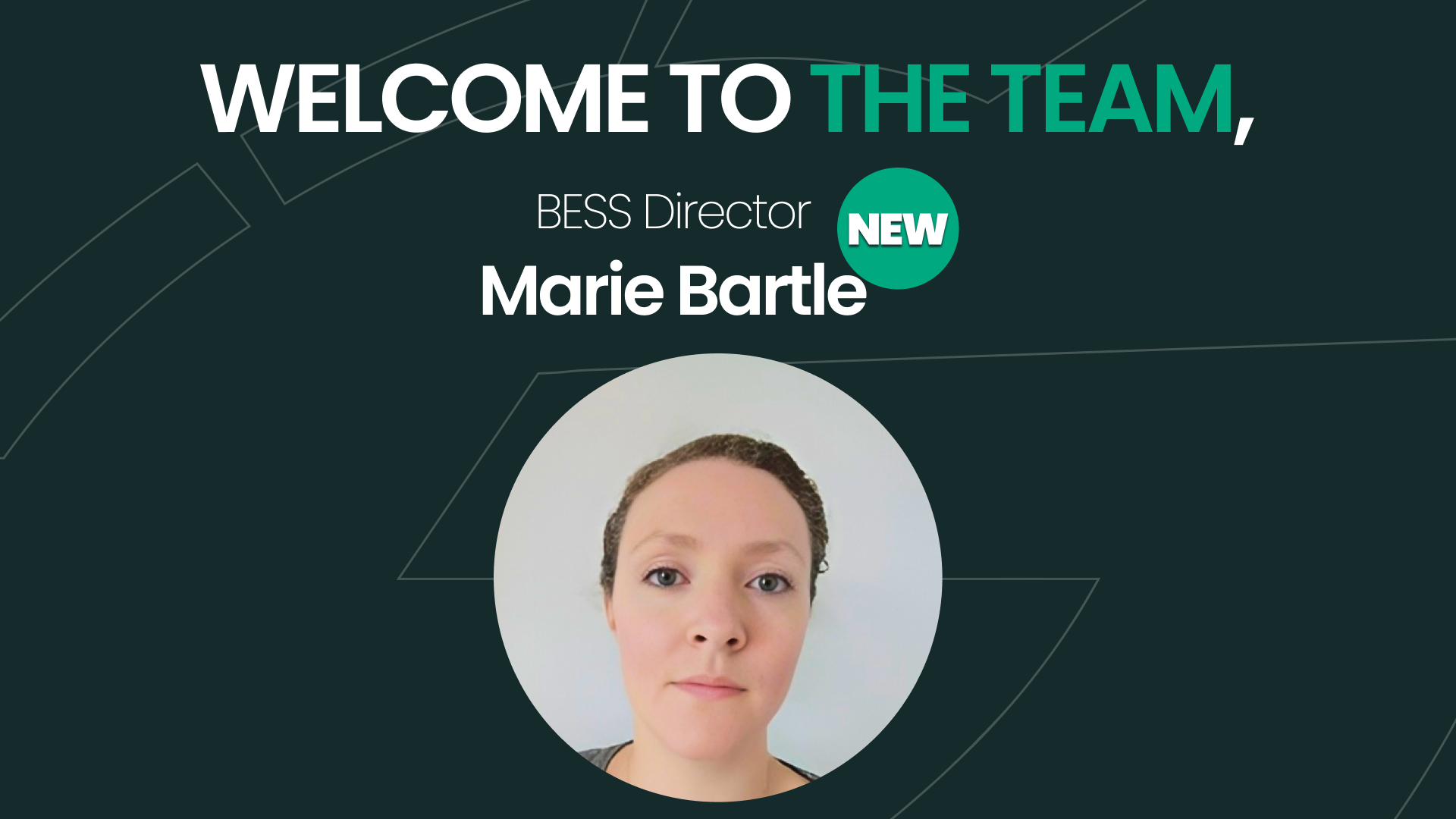
Marie Bartle Joins Greensolver as BESS Director
Marie Bartle Joins Greensolver as BESS Director
Europe is installing batteries faster than it is building operating experience with them. As storage moves from a niche add-on to a core asset class in investor portfolios, the decisive question is no longer whether to build a BESS, but how to make it perform, safely and profitably, over its life. To support our clients on that question, Marie Bartle joined Greensolver as BESS Director at the beginning of September, based in London.
Table of Contents
- A storage market growing faster than its operating track record
- Five years at the centre of the global storage market
- Where BESS value is actually won or lost
- What changes for Greensolver clients
- Conclusion
- Sources
A storage market growing faster than its operating track record
The numbers leave little room for doubt. According to EUPD Research, European battery storage installations are forecast to reach 57 GWh in 2026, up 78% on the 32 GWh installed in 2025, with Germany, Bulgaria, Italy, the United Kingdom and Spain leading the way. SolarPower Europe recorded a further record year in the EU alone, with 27.1 GWh added in 2025 and cumulative capacity reaching 77.3 GWh, against a requirement of roughly 750 GWh by 2030 to meet the bloc’s flexibility needs. The tenth European Market Monitor on Energy Storage, published by Energy Storage Europe and LCP Delta, puts front of the meter battery capacity at 18.5 GW / 34.4 GWh at the end of 2025.
Capacity, in other words, is arriving. Operating history is not — at least not at the same speed. Most of Europe’s grid-scale fleet has been energised in the last thirty-six months, which means the industry is still accumulating hard evidence on degradation behaviour, availability under intensive cycling, warranty enforcement and revenue durability. That gap between deployment and experience is precisely where owners, lenders and investors need independent support.
Five years at the centre of the global storage market
Marie Bartle spent the last five years as Global Head of Energy Storage at a major European advisory firm. Over that period she worked on around 10 GW of BESS projects and with clients in more than 50 countries, spanning 6 continents, across battery storage, wind and solar PV.
That combination matters. Storage is rarely evaluated in isolation any more: co-located and hybrid configurations mean the same grid connection, the same land, and often the same investment committee, must be assessed across two or three technologies at once. An advisor who has underwritten wind and solar assets as well as batteries reads those trade-offs differently from a pure storage specialist.
In her own words:
“Greensolver’s operational knowledge is second to none, with a combined service of Asset Management, Financial and Technical Advisory services a holistic perspective of renewable energy facilities at all stages of the lifecycle of a project. I am so happy to be part of the team and can’t wait to find out what we can do together.”

Where BESS value is actually won or lost
Three questions dominate the conversations our clients are having in 2026, and each one sits at the intersection of technical and financial analysis.
1. Which revenue model, and at what cost to upside? European markets have effectively split in two. In contracted and hybrid markets such as Italy, Poland and the United Kingdom, long-term capacity or tolling arrangements underpin unlevered IRRs in the 12–17% range. In merchant-exposed markets such as Germany, France and the Netherlands, returns depend far more on trading sophistication, with ancillary services still accounting for a large share of income for short-duration assets — up to 67% for a typical two-hour German battery. Tolling, floor-plus-share and fully merchant structures each shift risk to a different party, and the choice determines both gearing and the level of scrutiny lenders will apply.
2. How hard should the asset be worked? Revenue stacking is not a free lunch. Research on the GB market shows that participation in the Balancing Mechanism alongside wholesale arbitrage can lift revenues substantially, while a 10% increase in skipped bids erodes profit by around 7%, or roughly £12,000 per MW per year. At the same time, more frequent cycling accelerates degradation. Optimising dispatch without quietly consuming warranty headroom requires a degradation model that the owner — not only the optimiser or the OEM — can interrogate.
3. Is the safety and compliance case robust? Thermal runaway mitigation, fire strategy, permitting documentation and site HSE arrangements are now front and centre in due diligence, in insurance negotiations and in planning consent. They are also the areas where an inherited, unreviewed project file causes the most trouble post-acquisition.
None of these questions can be answered by a technical review or a financial model working in isolation. That is the logic behind Greensolver’s integrated approach to BESS, combining technical advisory, financial consultancy and health and safety advisory with long-term asset management.
What changes for Greensolver clients
Marie’s remit is deliberately practical. She is developing Greensolver’s BESS offering, working alongside our commercial teams on client deliverables so that technical depth reaches proposals and reports directly, and representing our storage expertise at industry events across Europe.
Operating from London puts her in one of Europe’s most demanding storage markets, where the Balancing Mechanism, capacity contracts and a maturing merchant landscape have already produced several years of real dispatch data. Greensolver Asset Management was appointed, following a competitive tender, to support a client’s battery storage operations in the United Kingdom — the kind of mandate that turns market theory into operational evidence.
For clients, the practical effect is a shorter route between question and answer: a single senior point of contact who can frame a storage business case, challenge a degradation assumption, and stay involved once the asset is operational. If you want to explore a specific project or portfolio with her, you can reach out through our contact form.
Conclusion
Europe’s storage boom is real, but capacity additions alone are a poor proxy for value creation. The assets that outperform over the next decade will be those whose owners understood, before financial close, what their revenue model demanded of the hardware — and who then kept measuring it. Strengthening our BESS leadership is a direct response to that shift.
The next question is one we hear increasingly often: as co-located wind-plus-storage and solar-plus-storage projects become the norm rather than the exception, how should owners govern assets that answer to two different market logics at once? We will return to it in a future article. In the meantime, our webinar replay on modelling the economic potential of BESS covers how we approach uncertainty in storage business cases.
Sources
- Europe’s storage market to hit 57 GWh in 2026, says EUPD Research — ESS News
- EU installs record 27 GWh of battery storage capacity in 2025 — S&P Global, on SolarPower Europe’s EU Battery Storage Market Review
- European Market Monitor on Energy Storage (EMMES 10) — Energy Storage Europe & LCP Delta
- Europe’s Battery Storage Edge — Capstone
- Battery storage: strategies for revenue stacking and investment success — Macquarie Asset Management
- Balancing with batteries: the impact of revenue stacking and skip rates — Journal of Energy Storage
Written by Paul Prieto, Marketing Manager