Buying Time: How an On-Site Battery Gets a Data Center Online Two Years Earlier
Summary
1. Connect now, firm up later: flexible connections and BYOC
2. Why the battery matters more than the solar panels
3. The grid is the critical path, and regulators are starting to act
4. Our case: a 30 MW data center that does not wait for the grid
5. The numbers: what two years are worth
6. The value grows with the queue
Conclusion
Introduction
In December 2025, Camus Energy, the modelling firm encoord and Princeton University’s ZERO Lab published a white paper funded by Google. Their question was simple: what if a data center did not have to wait for the grid? They used real grid data from a utility in PJM, the largest power market in the United States, and tested six possible sites of 500 MW each.
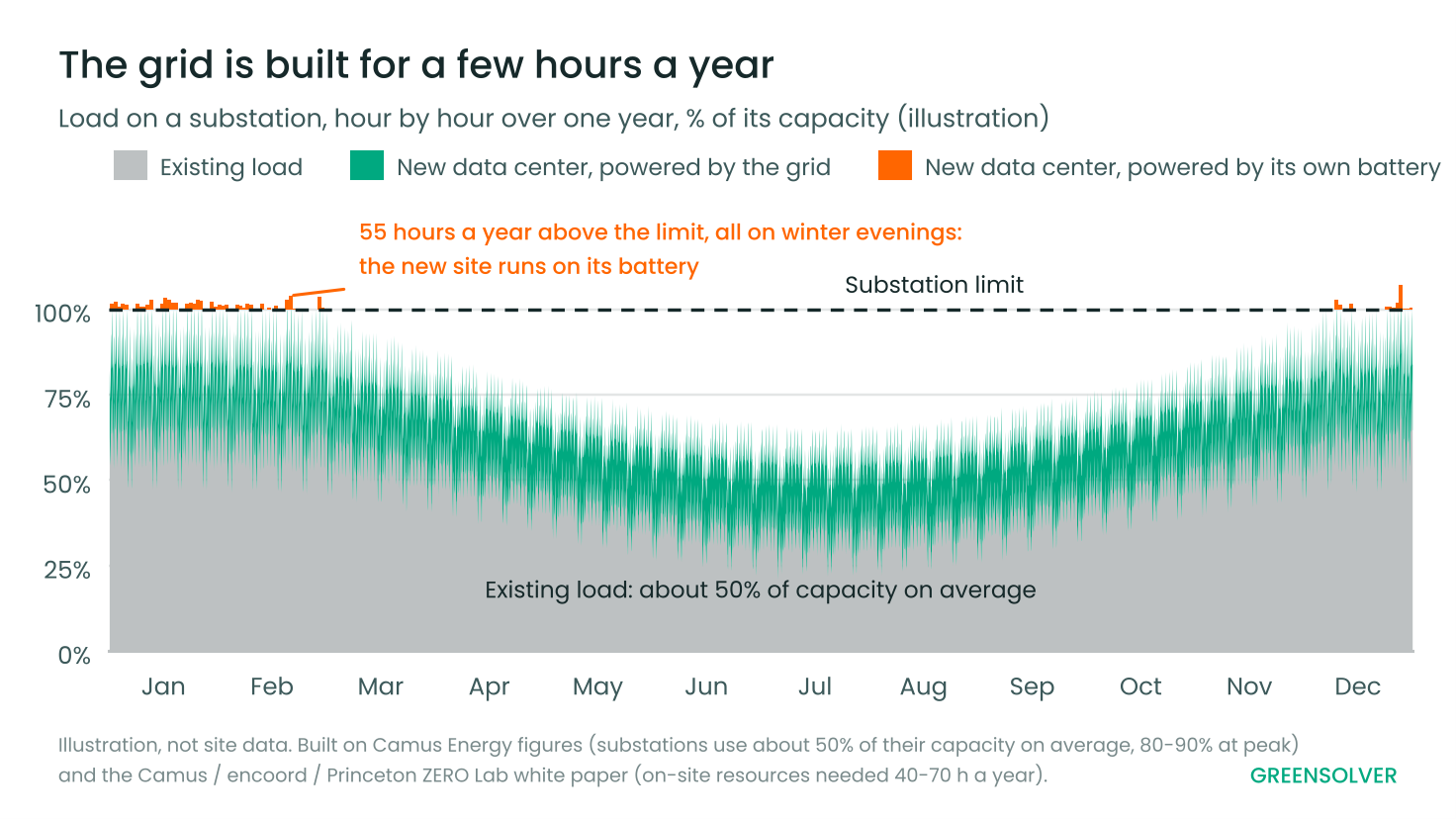
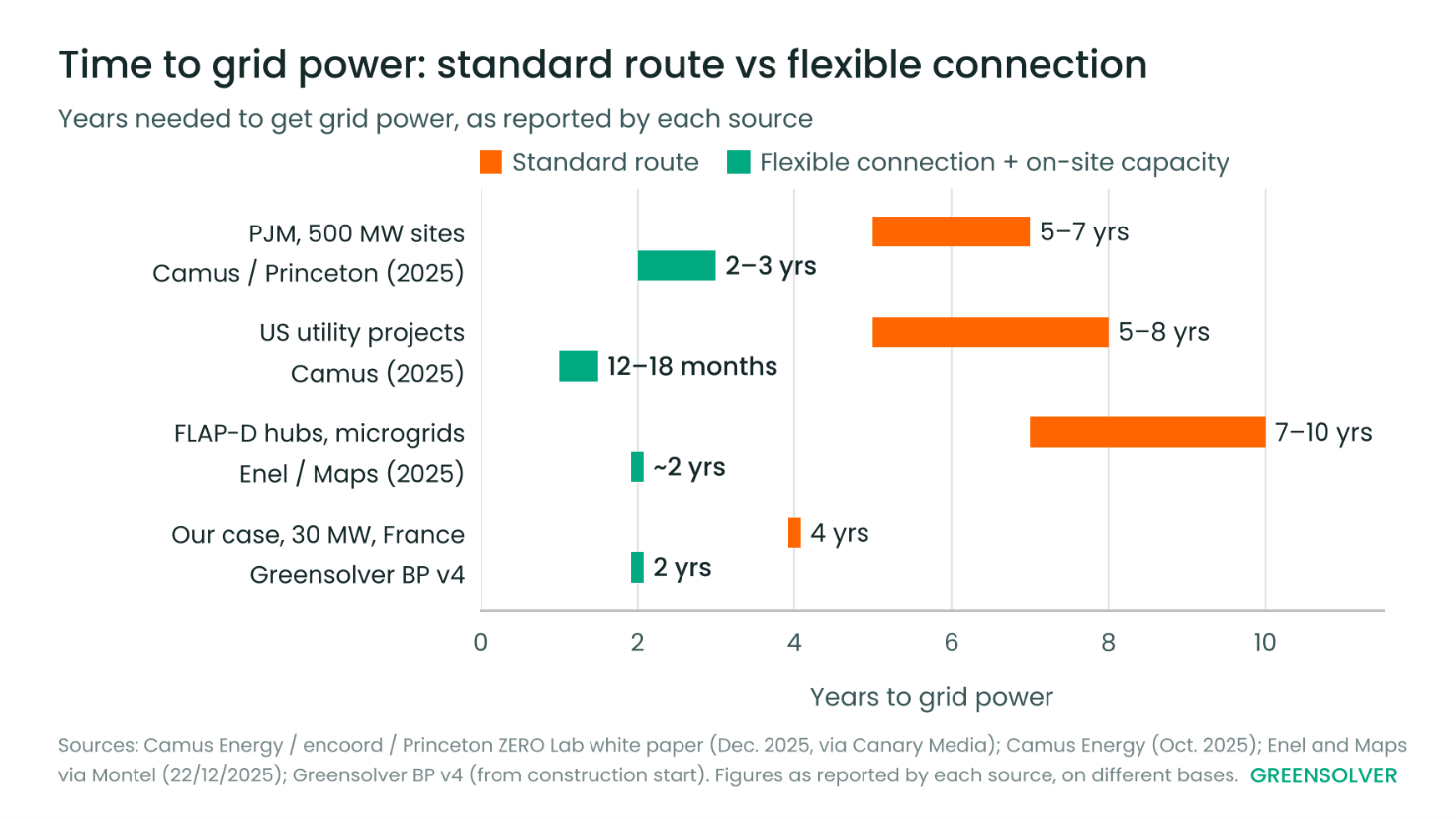
Their finding is that a data center that accepts a flexible grid connection and brings its own capacity can be fully running in about two years. That is three to five years sooner than the normal process. In their test, the grid supplied the data center more than 99% of the time. For the other 40 to 70 hours a year, the site used its own battery or generators.
The problem is the peak, not the average. A grid is sized for its busiest hours. Camus notes that many substations use only about half of their capacity on average and get close to their limit only at peak times. These peaks are short, 4 to 16 hours each, and in France they usually fall on cold winter evenings.
Europe has the same problem, sometimes worse. In October 2026, Microsoft dropped what was meant to be the UK’s largest AI data center, in Loughton, Essex, after the local network operator said the power connection would not be ready in time. For a data center, the grid connection is now the main constraint.
At Greensolver, we wanted to put numbers on this solution. We built a business plan for a 30 MW IT data center with a solar plant and a battery on site and compared it with the same data center connected to the grid only.
1. Connect now, firm up later: flexible connections and BYOC
With a normal (firm) connection, the grid operator promises the full power the data center asks for, every hour of the year. To keep that promise, it must first check that the network can carry the new load at its busiest moment. Very often, this means building new lines, transformers or substations, and that is what takes years.
A flexible connection works differently. It lets a data center connect earlier by using spare network capacity that is available most of the year, rather than waiting for new grid capacity or substations. The grid operator guarantees only part of the power the data center needs. The rest is available most of the time, but the operator can cut it during the few hours a year when the network is full, usually on cold winter evenings. In the Camus study, these cuts covered 40 to 70 hours a year. When the operator sends the signal, the site must lower what it takes from the grid, for example by using its own battery, its backup generators or by moving some load to later. Once the network has been reinforced, the connection can become firm.
Bring your own capacity (BYOC) solves a different problem. A new data center does not only need cables; it also needs enough power plants running at the peak. With BYOC, the data center brings that capacity itself: a battery or generation on site, a PPA, or flexible demand. In Europe, the most direct version sits behind the meter: a solar plant and a battery on the same site, behind the same connection point as the data center.
“Flexible connections address transmission bottlenecks, while BYOC addresses generation bottlenecks.” Camus Energy, encoord and Princeton ZERO Lab, December 2025
The battery does three jobs. First, it keeps the servers running when the grid operator curtails the site. Second, it counts as firm capacity, so the site reserves less power from the grid: in our business plan, the 20 MW battery cuts the grid capacity the site must subscribe by 7.4 MW. Third, it charges when power is cheap and discharges at peak times, which lowers the energy bill and flattens the daily peaks that drive grid fees. Ireland has already made on-site capacity a rule: large data centers must bring their own generation or storage to connect.
Together, these two ideas (BYOC and flexible connection) cut the long wait that data centers face today. According to Latitude Media’s coverage of the study, coming online three years earlier could add 2.3 to 3.2 billion dollars of earnings per 500 MW site, and the data centers would cover 96% to 100% of the extra system costs needed to serve them.
In Hillsboro, Oregon, Aligned Data Centers, the utility Portland General Electric and Calibrant Energy are building a 30 MW / 60 MWh battery next to an Aligned campus, due in 2027. The battery charges off-peak and discharges at peak, so the site relies less on the grid when the grid is tight. Aligned says it chose this route “instead of waiting years for grid upgrades”.
Europe has its own early examples. In West London, SSEN Distribution and National Grid used ramped connections and flexibility services, including battery storage, to give 10.5 MVA (around 10 MW) projects with connection dates in the 2030s a path to connect within 12 to 24 months. At a larger scale, Aurora Energy Research estimates that flexible connections alone could unlock an extra 20.9 GW of AI computing capacity in Europe by 2030, with curtailment limited to about 2.5% of the most constrained periods.
Side by side, the time saved is counted in years:
2. Why the battery matters more than the solar panels
A data center needs power day and night. Tier III sites are usually associated with 99.982% availability, or about 1.6 hours of downtime a year, and their tenants sign contracts on that basis.
This is where the battery comes in. When the grid operator curtails the site, the battery keeps the servers running. The grid sees a flexible customer and the tenant sees no interruption. These events are short and rare: 40 to 70 hours a year at the Camus sites, and about 1.5% of the hours of the year in Europe according to Agora Energiewende and Deloitte. A four-hour battery covers most of them; the longest ones rely on load flexibility or on the backup generators that Tier III sites already have.
Solar produces nothing at 7 pm in January, which is often when the grid is under the most stress. In our model, the solar plant and the battery together cover about 16% of the data center’s consumption, hour by hour. The solar plant lowers the energy bill and adds local green power, but it is the battery that makes the early connection possible.
3. The grid is the critical path, and regulators are starting to act
A data center takes 18 to 24 months to build. A grid connection takes much longer: more than four years on average in primary markets according to JLL, and seven to ten years in the FLAP-D hubs of Frankfurt, London, Amsterdam, Paris and Dublin according to the IEA (International Energy Agency). In France, the wait has moved from two or three years to more than five, sometimes seven.
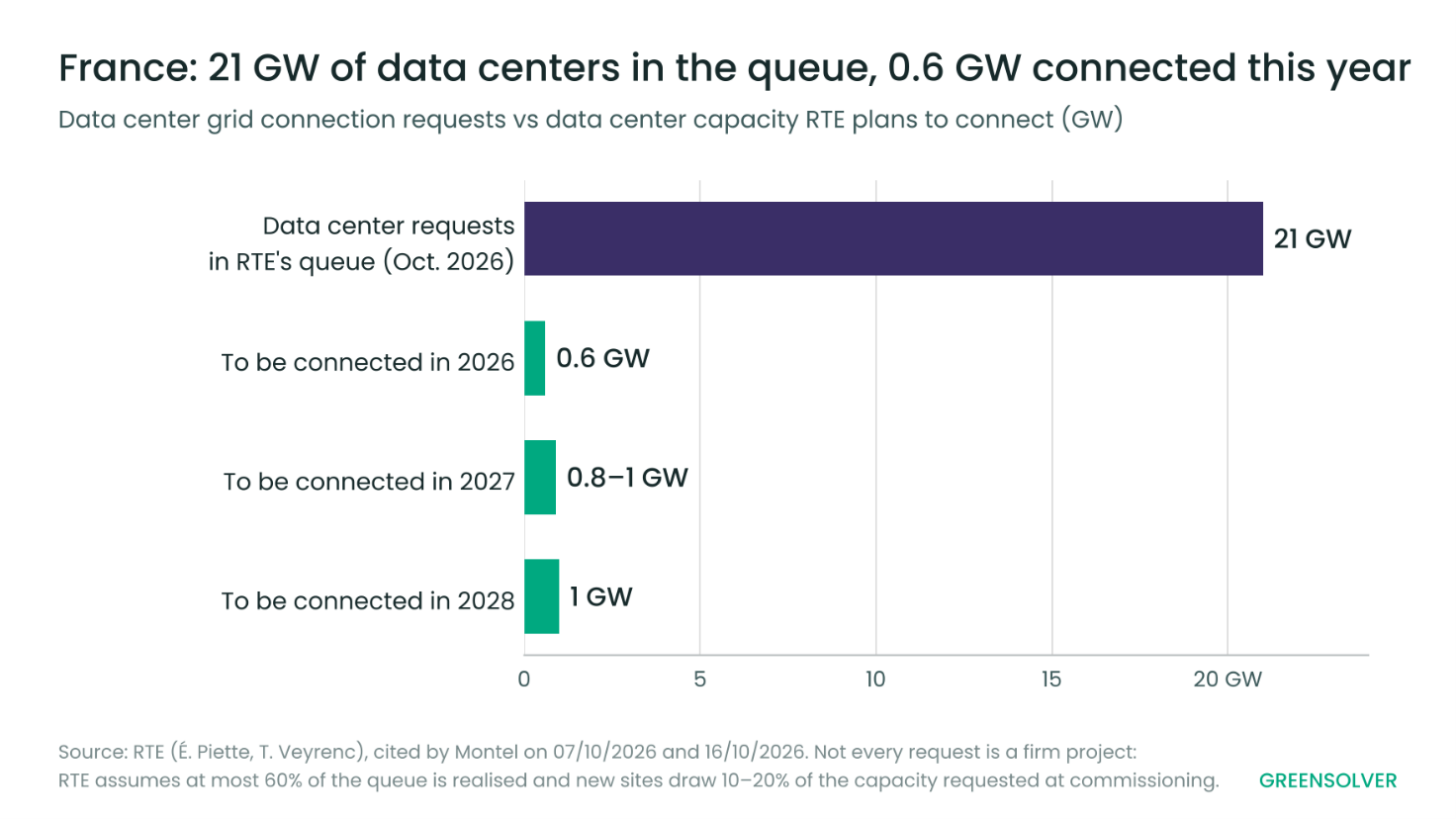
RTE, the French transmission system operator, has 21 GW of data center projects in its connection queue, out of about 36 GW of consumption requests. RTE expects to connect around 0.6 GW of data centers in 2026, 0.8 to 1 GW in 2027 and 1 GW in 2028. Not every request will turn into a real project, and RTE notes that new data centers use only 10% to 20% of the capacity they asked for when they start.
Regulators are starting to treat flexibility and on-site resources as part of the answer:
- Ireland: since the CRU decision of December 2025, data centers of 10 MVA or more must bring dispatchable generation or storage, on site or close by, matching their maximum import capacity. They must also cover at least 80% of their annual demand with new Irish renewables within six years.
- Spain: a draft royal decree, expected in autumn 2026, would require data centers above 1 MW to cover 80% of their consumption with new renewable capacity, matched hour by hour, on site or through long-term PPAs. The Spanish regulator CNMC has also created flexible grid access permits for new demand.
- European Union: the proposed Cloud and AI Development Act (June 2026) asks Member States to make flexible connection agreements easier and to remove barriers to PPAs. The new EU rating scheme for data centers (September 2026) scores both flexibility and new low-carbon supply.
- France: there is no standard non-firm connection for consumers yet. The CRE lets a site connect sooner if it does not ask for its full power on day one, with a ramp-up over as long as ten years (deliberation 2024-229). Curtailable connections are so far defined only for storage (deliberation 2026-173). In October 2026, RTE announced a pilot in the Paris region to free at least 1 GW for new consumers without waiting for heavy grid works, with power raised step by step. The government also plans to let solar and battery hybrids connect to the medium-voltage network up to 25 MW, against 17 MW today.
4. Our case: a 30 MW data center that does not wait for the grid
Our business plan models a 30 MW IT, Tier III colocation data center in France. Construction starts in January 2027 and lasts 24 months. We compare two cases:
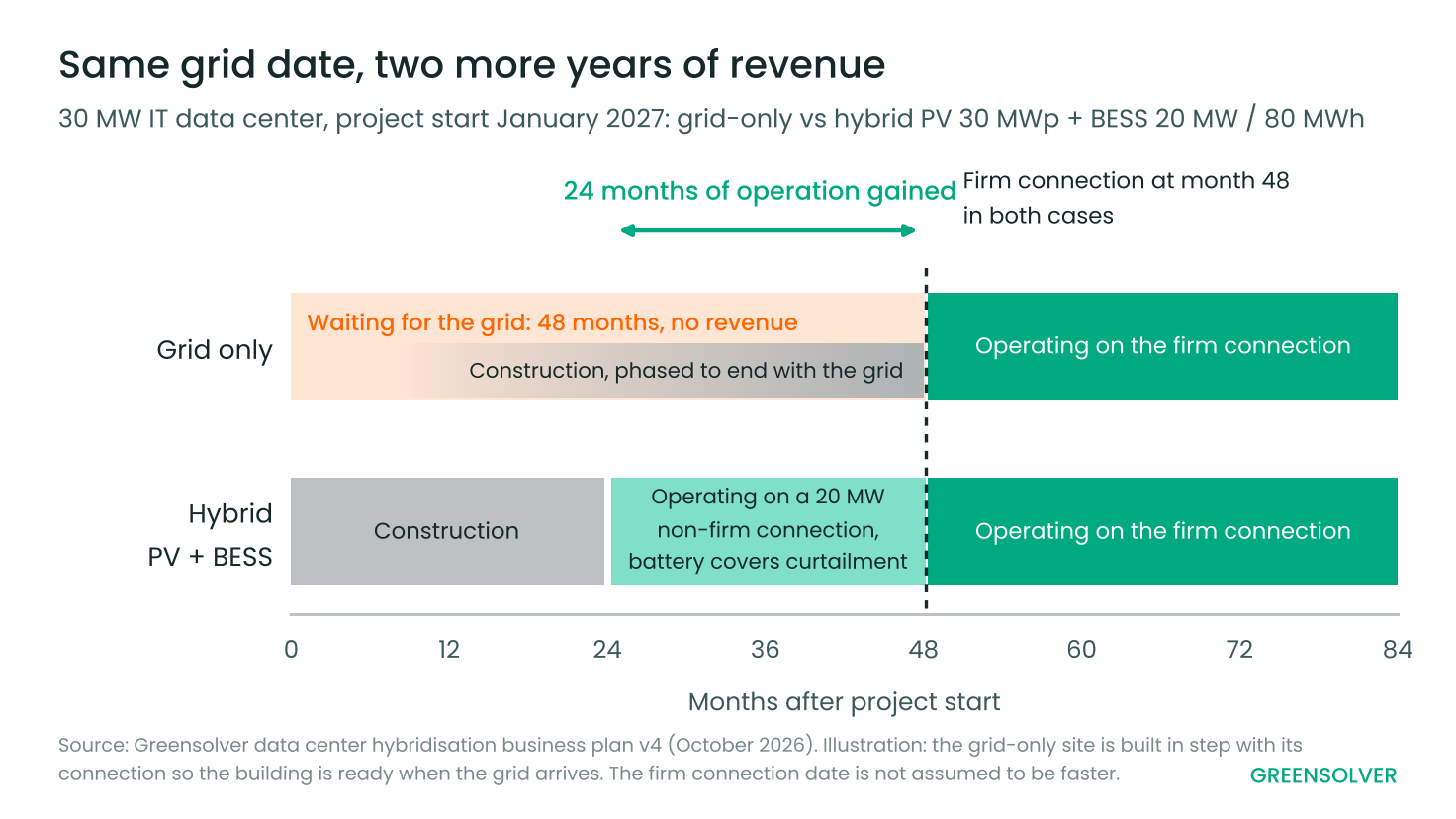
- Grid only: the firm grid connection arrives 48 months after construction starts, in line with JLL’s “more than four years”. In our model, the building is finished after 24 months and waits 24 more months with no revenue. A developer could also start building later so that the site is ready when the grid arrives (chart below): this saves part of the carrying costs, but it does not bring the first revenue forward.
- Hybrid: the same data center with a 30 MWp solar plant and a 20 MW / 80 MWh battery on site. It starts on a 20 MW non-firm connection as soon as construction ends, and the battery covers curtailment events. The full firm connection arrives at month 48, exactly as in the grid-only case.
We do not assume that the grid gets any faster. Occupancy at maturity is 90% in both cases and the lease-up (commercial ramp-up) is the same. The only differences are the start date and the on-site system. In the hybrid case, the 20 MW interim connection limits the second year of operation to 14.7 MW of IT load, which keeps the ramp-up realistic. Twenty-four months is also at the low end of the gains shown in section 1, which are mostly three years or more. In France, this interim connection is still a forward-looking case (see section 3): it has to be agreed with RTE or Enedis, for example through a stepped increase of the connection capacity.
5. The numbers: what two years are worth
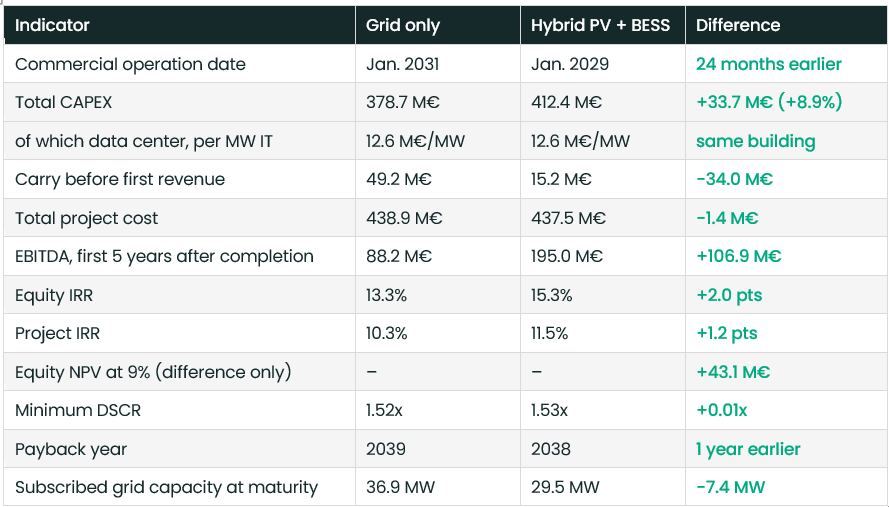
Source: Greensolver data center hybridisation business plan v4. 30 MW IT Tier III colocation, France, base rent 169 €/kW IT/month; hybrid = PV 30 MWp + BESS 20 MW / 80 MWh.
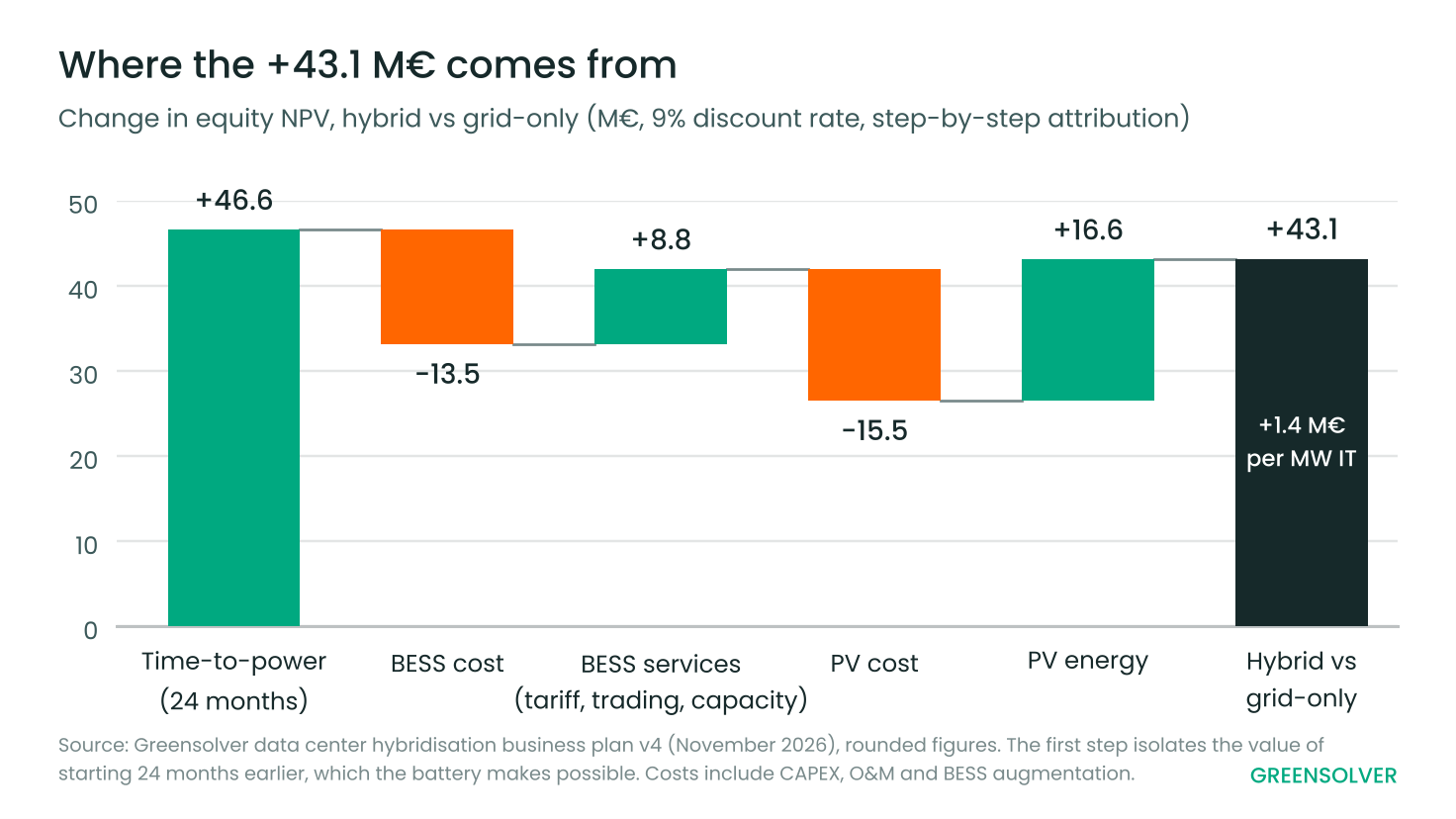
Starting 24 months earlier is worth 46.6 M€. Those months are only available because the battery makes the non-firm connection acceptable. In NPV terms, the battery costs 13.5 M€ (CAPEX, O&M and augmentation) and earns back 8.8 M€ by cutting the grid capacity charge, trading and earning capacity revenues. The solar plant costs 15.5 M€ and brings 16.6 M€ in avoided power purchases and exported surplus.
6. The value grows with the queue
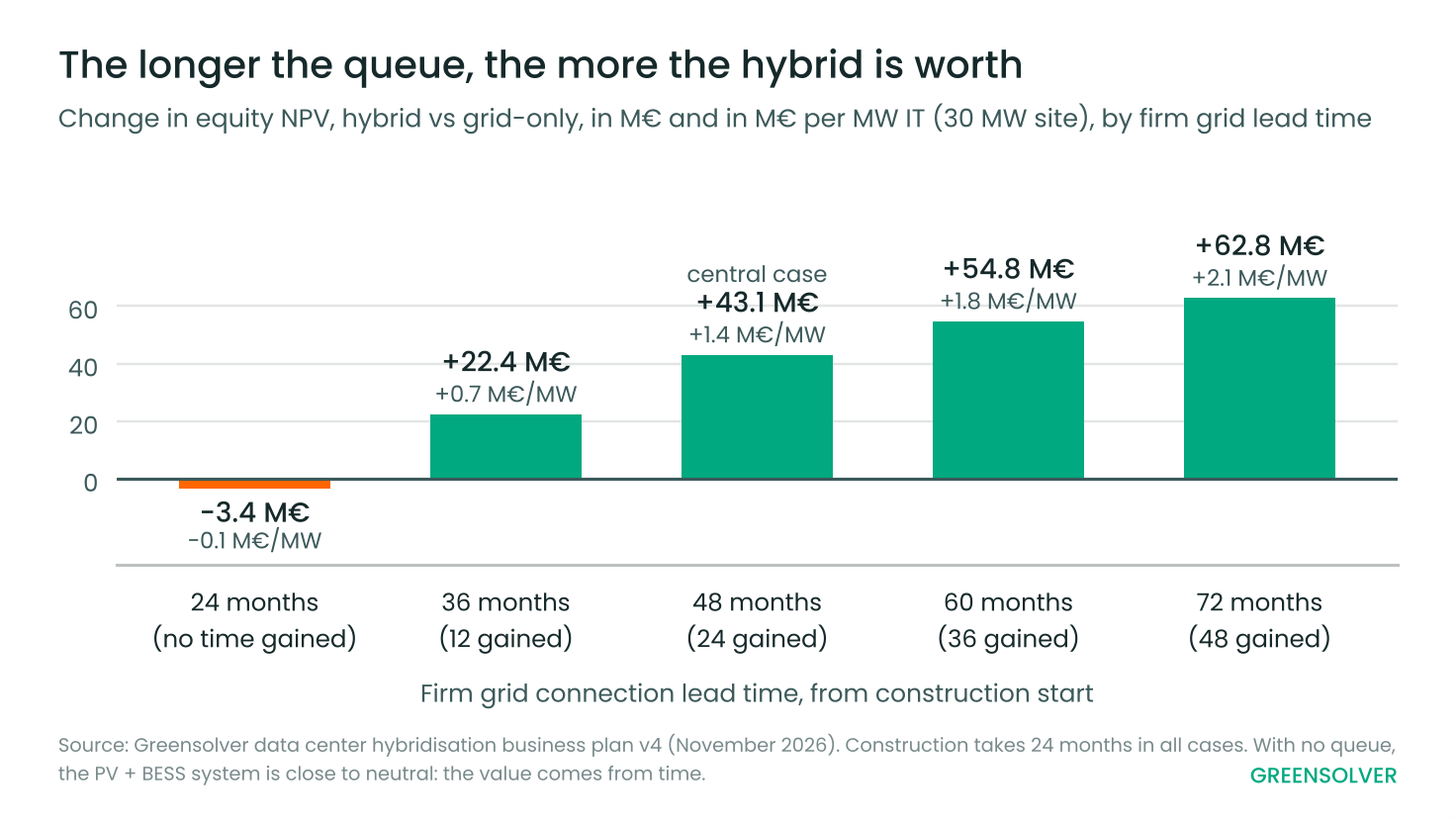
Hybridization makes sense because the grid queue is usually longer than the construction time. If the grid were ready on the day construction ends, the solar and battery system would be slightly negative, at -3.4 M€ of equity NPV. Its value comes almost entirely from time, so it grows with the queue: +22.4 M€ with 12 months gained, +43.1 M€ with 24 and +62.8 M€ with 48.
Conclusion
The Google-funded study showed it for 500 MW sites in the United States. Our business plan shows it for a 30 MW site under French assumptions: when the grid is the bottleneck, an on-site battery is the cheapest way to buy time, and time is what drives returns in this sector. And the solar plant lowers the energy bill and adds local green power.
For developers, investors and lenders, the key question about a data center project is no longer only how much it costs per MW. It is also when it will get its power, and what the plan is if the grid is late.
Greensolver helps data center developers, investors and lenders answer that question. We can study a hybrid solution for your site: sizing of the solar plant and the battery, grid connection strategy, business plan, sensitivities and bankability. Contact us to discuss your project.
Written by Guillaume Dubois
Sources
Sources classées par section de l’article. Les liens Montel nécessitent un abonnement ; les documents marqués « internal » ne sont pas publics.
- Camus Energy (S. Brisley), “How Flexible Connections Help Data Centers Connect To The Grid In 12-18 Months”, updated 13/10/2025. https://www.camus.energy/blog/how-flexible-interconnections-can-help-data-centers-connect-faster-without-overloading-the-grid
- pv magazine (B. O’Dea), “On-site batteries accelerate grid access for data center developers”, 19/03/2026. https://www.pv-magazine.com/2026/03/19/on-site-batteries-accelerate-grid-access-for-data-center-developers/
- Aligned Data Centers (M. Chambliss), “Solving for Speed-to-Power, At Scale”, 02/12/2025. https://aligneddc.com/blog/solving-for-speed-to-power-at-scale/
- Camus Energy, encoord, Princeton University ZERO Lab, “Flexible Data Centers: A Faster, More Affordable Path to Power”, December 2025 (sponsored by Google). https://www.rtoinsider.com/wp-content/uploads/2025/12/Whitepaper-dec-2025.pdf
- Latitude Media (M. Allsup), “A Google-backed blueprint for FERC’s data center fast lane”, 05/12/2025. https://www.latitudemedia.com/news/a-google-backed-blueprint-for-fercs-data-center-fast-lane/
- Utility Dive (D. DiGangi), report on flexible grid connections and BYOC for data centers, 04/12/2025. https://www.utilitydive.com/news/flexible-grid-connections-byoc-data-centers-utilities/807047/
- American Public Power Association, “Report details benefits of combining flexible grid connections with bring your own capacity”, 05/12/2025. https://www.publicpower.org/periodical/article/report-details-benefits-combining-flexible-grid-connections-with-bring-your-own-capacity
- Canary Media (J. St. John), “PJM needs flexible data centers”, 07/01/2026. https://www.canarymedia.com/articles/data-centers/pjm-needs-flexible-data-centers
- Data Center Knowledge / Bloomberg, “Flexible Power Accelerates Data Center Projects, Princeton Says”, 04/12/2025. https://www.datacenterknowledge.com/energy-power-supply/flexible-power-accelerates-data-center-projects-princeton-says
- Montel (A. Trabattoni), “‘Microgrids’ could slash data centre waits to 2 years – industry” (Enel, Siemens, Maps), 22/12/2025. https://markets.montel.energy/news/article/b0c5cf52-d54a-4cea-ad70-260c4b3f5e74
- City AM, “Microsoft pulls out of Nscale deal for UK’s largest AI data center”, 19/10/2026. https://www.cityam.com/?p=2466628
- Montel (R. Newbold), “Microsoft pulls out of UK data center plan amid power supply fear”, 19/10/2026. https://markets.montel.energy/news/article/1cfba155-86fc-4e1c-8a8e-06a6caf20aed
- SSEN Distribution, “Networks collaborate to accelerate connection timescales in West London”, 13/03/2024. https://www.ssen.co.uk/news-views/2024/Networks-collaborate-connection-timescales-west-london/
- Montel (J. Glenister), “Flexible grid could double expected UK 2030 AI capacity – Aurora”, 30/09/2026. https://markets.montel.energy/news/article/47110f84-c98b-4718-8fa0-35c9a2fe3438
- Montel (J. Glenister), “Irish data centers can’t accept interruptible grid tariffs – lobby”, 02/10/2026. https://markets.montel.energy/news/article/3df50ada-6143-4c58-a16a-ef059af29c97
- Agora Energiewende / Deloitte, “Value and enablers of data center flexibility in Europe”, 2026. https://www.agora-energiewende.org/publications/value-and-enablers-of-data-centre-flexibility-in-europe
- Uptime Institute tier levels as cited by ABB Review 4|13 (M. Glinkowski, “Designed for uptime”) and CoreSite: Tier III is commonly associated with 99.982% availability, about 1.6 hours of downtime a year. Uptime defines tiers by design (Tier III = concurrently maintainable), not by a percentage.
- Construction Owners Association, “How long it actually takes to power a data center in 2026”, 07/2026. https://www.constructionowners.com/insights/how-long-it-actually-takes-to-power-a-data-center-in-2026-a-u-s-market-by-market-reality-check
- JLL, Global Data Center Outlook 2026 (lead times above four years in primary markets). https://www.jll.com/en-uk/insights/global-data-center-outlook
- IEA, “Overcoming energy constraints is key to delivering on Europe’s data center goals”, 2025 (7 to 10 years in FLAP-D). https://www.iea.org/commentaries/overcoming-energy-constraints-is-key-to-delivering-on-europe-s-data-centre-goals
- Groupe de travail numérique sur l’électrification des usages (“Plug Baby Plug”), report, May 2026. https://www.greenunivers.com/wp-content/uploads/2026/05/Rapport-Groupe-de-travail-numerique-sur-lelectrification-des-usages-1-1.pdf
- Montel (M. Boselli, C. Pailliez), “French TSO urges reforms as grid connections surge 8-fold”, 07/10/2026. https://markets.montel.energy/news/article/a60fc3db-6e8e-43dd-bf6c-463195ef7dab
- Montel (C. Pailliez), “French TSO calls for transparency over data center grid requests”, 16/10/2026. https://markets.montel.energy/news/article/e5557fb6-671e-4683-bcb3-07807621ccb5
- Arthur Cox, “New connection policy for data centers in Ireland” (CRU decision of 16/12/2025). https://www.arthurcox.com/knowledge/new-connection-policy-for-data-centres-in-ireland/
- Montel (R. de Miguel), “Spanish government requires data centers to use 80% green energy”, 27/08/2026. https://markets.montel.energy/news/article/f98f06a3-1b92-41f0-b78a-4fde887f36f9
- Montel (B. Belmonte), “Spanish data center regulation may boost PPA prices”, 02/10/2026. https://markets.montel.energy/news/article/c981cc81-7ea0-448d-ade5-626e606210a1
- Montel (A. Aeberhard), “Spanish regulator approves flexible demand grid access rules”, 11/08/2026. https://markets.montel.energy/news/article/a5f2719d-3192-433c-8166-f72effced418
- European Commission, Proposal for a Cloud and AI Development Act (CADA), COM(2026) 502, June 2026. https://digital-strategy.ec.europa.eu/en/library/proposal-cloud-and-ai-development-act-cada
- Montel (S. Hall), “EC unveils rating system for data centers’ energy use”, 21/09/2026. https://markets.montel.energy/news/article/b47af929-88ee-4334-b9b0-4df7c858a02f
- CRE, deliberation 2024-229 on connection capacity ramp-up. https://www.cre.fr/fileadmin/Documents/Deliberations/2024/241218_2024-229_Evolution__Puissance_Raccordement.pdf
- CRE, deliberation 2026-173 of 28/07/2026 on the RTE connection procedure (long-term limitations for storage). https://www.cre.fr/fileadmin/Documents/Deliberations/2026/260728_2026-173_Procedure_de_raccordement_RTE.pdf
- Atlante, “Raccordement électrique : RTE réforme la file d’attente” (Île-de-France pilot to free at least 1 GW, staged power increase), 26/10/2026. https://www.atlante.fr/raccordement-electrique-reforme-rte-file-attente-data-centers-industrie/
- Montel (S. Tetrel), “Le raccordement des projets solaires avec batterie sera facilité”, 15/10/2026. https://markets.montel.energy/news/article/260d0288-be56-45ba-a12e-049d1197acc3
- KPMG, Data center Benchmarking Index 2026. https://kpmg.com/ie/en/home/insights/2026/data-centre-benchmarking-index.html
- Turner & Townsend, Data Centre Construction Cost Index 2026-27 (Europe average 12.76 US$/W; scope excludes land, utility works and professional fees). https://www.turnerandtownsend.com/insights/data-centre-construction-cost-index-2026-27/
- CBRE, Global Data Center Trends 2026 (colocation rents, Paris 250-500 kW blocks: 175-205 US$/kW/month). https://www.cbre.com/insights/reports/global-data-center-trends-2026
- CRE, deliberation 2025-77 on the TURPE 7 HTB grid tariff (+3.34% on 01/08/2026). https://www.cre.fr/fileadmin/Documents/Deliberations/2025/250313_2025-77_Post-CSE_TURPE_7_HTB.pdf
- Opera Energie, reduced electricity excise for data centers, 01/10/2026. https://opera-energie.com/media/data-centers-eligibilite-taux-reduit-accise-electricite/
- Opera Energie, EDF CAPN long-term supply contracts. https://opera-energie.com/capn/
- CRE, note on PV + storage, 05/03/2026 (PV capture price, hybrid value). https://www.greenunivers.com/wp-content/uploads/2026/03/260305_Note_PV_Stockage.pdf
- Artelys, first auction of the new French capacity mechanism, 06/07/2026. https://www.artelys.com/news/first-successful-auction-for-new-french-capacity-mechanism/
- Montel (C. Pailliez), “Mécanisme de capacité : la CRE plus favorable aux batteries”, 09/10/2026. https://markets.montel.energy/news/article/c01b90fc-df86-42e9-b600-bd294b5b8f87
- Montel (P. Jowett), “Europe set for increase in 24/7 PPAs – experts” (Engie x Legrand), 14/09/2026. https://markets.montel.energy/news/article/f7fcc930-5ae8-434d-9add-c89d30fdbde0
- Greensolver, Data center hybridisation business plan v4 (DC_Hybridisation_BP_GRS_v4_EN.xlsx), re-run of 03/11/2026 with a 2% contingency on data center CAPEX, base rent 169.175 €/kW IT/month (internal).
- Greensolver, CAPEX/OPEX benchmarks for ground-mounted PV and BESS (four French EPC quotes, 2026) (internal).