Remote solutions to measure wind
Remote solutions to measure wind
Wind turbines are getting higher and bigger every year, making it increasingly difficult and costly to install a met mast high enough to have a representative measurement of the wind conditions at hub height and all over the rotor plane – especially for large projects.
Alternative and complementary solutions are available on the market to overcome this issue: remote sensor solutions. There are basically two types of remote sensors, aimed to assess the wind conditions for turbines: the Lidar (LIght Detection And Ranging) and the Sodar (SOnic Detection And Ranging). This article aims to explain these solutions, with the understanding that both can be used to complement a wind mast measurement campaign or as a stand-alone tool in specific situations.
Doppler Effect
First, it is important to understand how they work. For wind measurement, the Sodar and Lidar technologies both use the Doppler effect – one with sound beams, the other with light beams.
The Doppler Effect is characterized by the change of wave frequency between the transmitter and the receiver when the distance between them changes over the time. One typical example is the ambulance that passes nearby: when the ambulance moves closer the sound is high, but when it moves away the sound is deep. This is because the frequency of the waves is higher in front of the moving object.
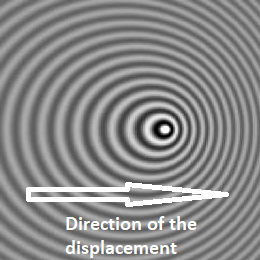
Figure 1: Doppler Effect on the wave frequencies
Sodar
The Sodar technology uses the thermal structures of the atmosphere. Its transmitter produces a pulse of sound which changes the frequency changes due to the Doppler Effect upon contact with the moving structures. The Sodar receiver receives this pulse and deduces the wind speed according to the new frequency. The height of measurement depends on the time that the pulse takes to come back to the receiver. Unlike the anemometers, the Sodar measures the wind on a circular area, created by several sound beams that create a cone.
Mono-static Sodar
The mono-static Sodar technology are the most used by the wind industry; the transmitter and the receiver are at the same location. This sensor is generally cheaper and has a lower consumption than the Lidars. But it is highly impacted by the echo produced by buildings or trees close to the Sodar.
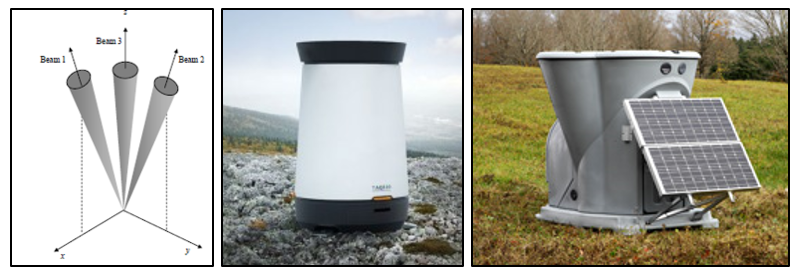
Figure 2 : Monostatic Sodar principle and examples (AQ510 by AQSystem, Triton by Vaisala)
Bi-static Sodar (under development)
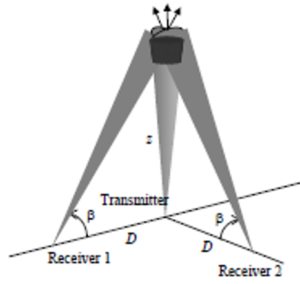
A bi-static Sodar uses the same principle as the mono-static Sodar but consists of separated transmitter and receivers. The more receiver there are allow a better turbulences’ measurement and error correction due to echoes. It is possible to place the transmitter on the nacelle and the receivers on the ground to measure the wind at hub height.
Lidar
Unlike the Sodar, the Lidar uses the particles in the air. Its transmitter produces a pulsed or continuous light which color changes due to the Doppler Effect upon contact with the moving particles. The receiver receives this light and deduces the wind speed according to the new color. A combination of several Lidar of the same technology can be used to improve the quality of the measurement.
Pulsed Lidar
This type of Lidar sends a pulse of light and determines the distance accordingly to the delay between the emission and the reception of the pulse. One pulse measures all the distances or heights programmed in the Lidar. Like the Sodar, the pulsed Lidar measures the wind on a circular area, thanks to several light beams. The range of measurements of this technology is between 30 m to 10 km.
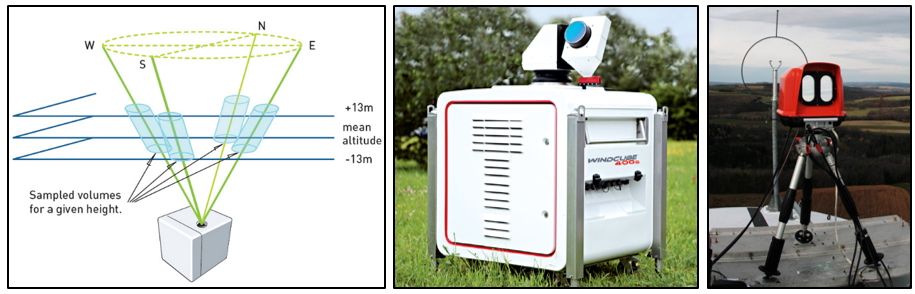
Figure 4 : Leosphere is a manufacturer of pulsed Lidars created for different uses (Windcube, Windcube x00S and Wind Iris)
CW Lidar
A Continuous Wave (CW) Lidar is able to create a collimated beam and adjusts the distance of the focus. The wind is measured where the beam is focused. The distances or heights programmed in the Lidar are measured one by one. The range of measurements of this technology is 10 m to 300 m.
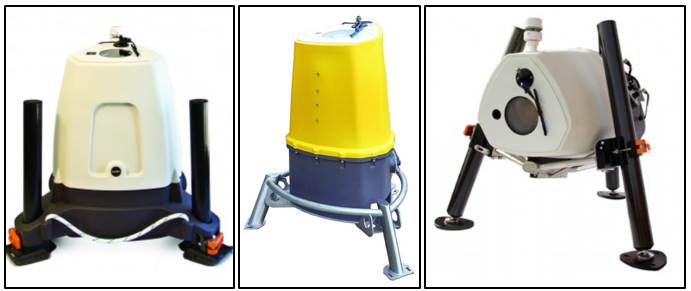
Figure 5 : ZephyR is a manufacturer of CW Lidars created for different uses (ZephIR 300, Zephir DM and Wind Iris)
How can Greensolver help?
Each remote sensor has its benefits and its downsides, which will be explained in an upcoming article. We know this topic well, if you want to use a remote sensor, do not hesitate to contact us, will be happy to assist you.
The Latest Renewable Energy News
Webinar Replay – Modeling the Economic Potential of BESS: How to Manage Uncertainty | June 17, 2:00 p.m. CET

Greensolver will be attending the 12th GreenUnivers Infrastructure Financing Conference on July 1
Greensolver at the National Event on “Flexibility in Renewable Energy and Storage” — July 2