Reshaping France’s Renewable Energy Market: The Role of BESS under PPE 3
France has released its long-awaited PPE3 (2026-2035), which defines the country’s energy strategy for the next decade.
Demand: Electricity demand is expected to increase, driven by industrial electrification, transport (EVs), heat pumps, and the expansion of data centres. Targets aim for 60% decarbonised energy use by 2030 and 70% by 2035, up from 42% in 2023. A national electrification plan will be published in May 2026.
Supply: Decarbonised electricity production is set to increase from 458 TWh in 2023 to between 650 and 693 TWh by 2035. Nuclear will remain the backbone of France’s energy system and is the primary beneficiary of PPE3, while renewables will continue to grow with renewed ambition.
Opportunities
France plans to increase its share of renewables by securing pipelines through public tenders for offshore wind (AO10: +6 GW), solar (+2.9 GW/year until 2028), and onshore wind (+1.8 GW/year until 2030). This creates greater visibility and confidence among developers and investors about the sector’s future.
The solar sector is expanding and benefits from attractive project economics. It offers fixed-tariff CfDs (AO CRE) that guarantee long-term revenues, reduced equipment costs, mature technology, and a faster, established development process.
Greensolver identifies battery storage and hybrid projects as the next major opportunities, particularly as the grid’s renewable share increases. Integrating BESS enhances grid efficiency and helps manage price volatility, curtailment, and episodes of negative electricity prices.
- BESS benefits from positive trends, including declining battery costs and a diversified revenue stack – combining market, fixed-tariff, ancillary service, and capacity market payments.
- To improve BESS bankability, projects can adopt fixed-price aggregator agreements (such as tolling or floor contracts). These arrangements allow for higher leverage and longer debt maturities, helping meet debt service coverage ratio (DSCR) requirements.
- BESS projects can achieve greater returns by increasing market exposure through arbitrage trading – charging when electricity prices are low and discharging when prices are high.
- Hybridising existing brownfield solar assets can boost project IRRs by unlocking additional revenue streams.
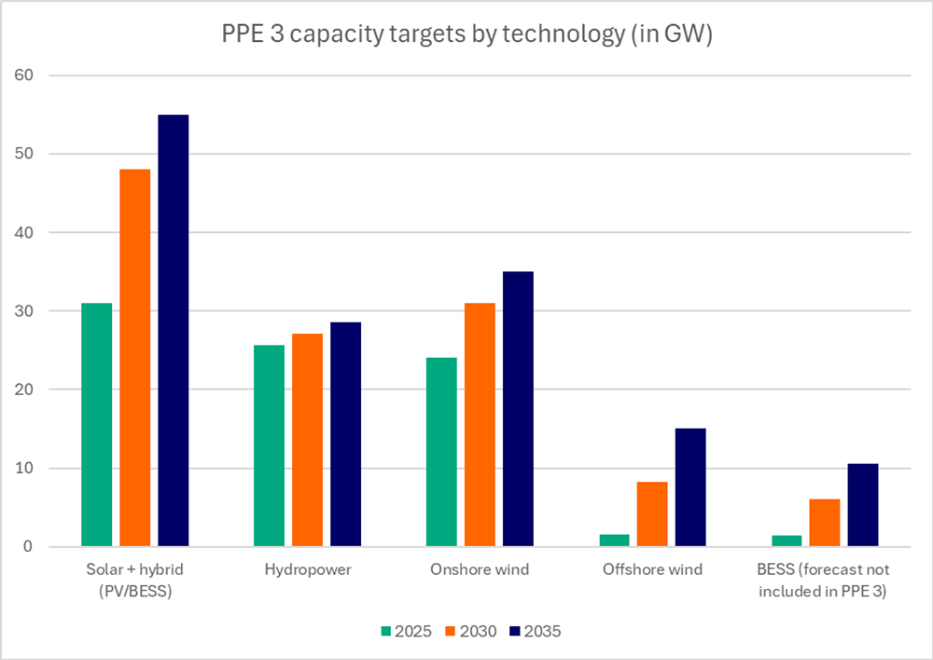
In 2025, France’s battery storage capacity stands at 1.5 GW. The PPE 3 does not set any targets for BESS. Based on current market estimates, Greensolver expects battery storage installed capacity to reach 5.4 GW by 2030, and nearly 10 GW by 2035.
Risks
Rising electricity prices and potential for deindustrialisation could lower demand growth, potentially causing it to fall short of current forecasts. PPE 3 includes a review clause in 2027, based on changes in electricity consumption.
There is a risk of oversupply in electricity production, but France’s interconnections and its role as a major electricity exporter help to mitigate this.
Reliance on storage will require more equity capital, as BESS assets are financed at lower gearing ratios than wind and solar assets. Battery storage presents risks because it is still emerging, faces evolving regulations, has limited lending precedents, and involves greater operational complexity in managing and optimising multiple revenue streams.
Market saturation poses a risk for battery storage due to potential oversupply and revenue cannibalisation, reinforcing the need for diversified revenue streams and fixed-price agreements.
Uncertainty exists regarding the optimal duration for BESS projects, with newly announced projects targeting 2 hours, while longer-duration batteries reach 3-4 hours.
Grid saturation and permitting hurdles may limit the deployment of new renewable capacity. Investments in grid reinforcement will be critical. Battery storage and optimisation software can help enhance grid efficiency.
Greensolver’s Contribution
Greensolver brings extensive experience supporting every stage of storage or hybrid project lifecycle, including:
- Conducting comprehensive market and regulatory framework analyses to inform investment decisions
- Developing and evaluating business models, as well as performing revenue stack modelling (in partnership with StackEase)
- Optimizing system sizing and providing robust technical design solutions
- Evaluating and selecting reliable equipment, including BESS OEMs, PCS, and EMS
- Performing financial and technical due diligence for investors and banks
- Providing asset management services throughout the operational phase
Our team is ready to discuss how we can support your next steps in the sector.
Written by Simon Hery, Project Finance/M&A Analyst